
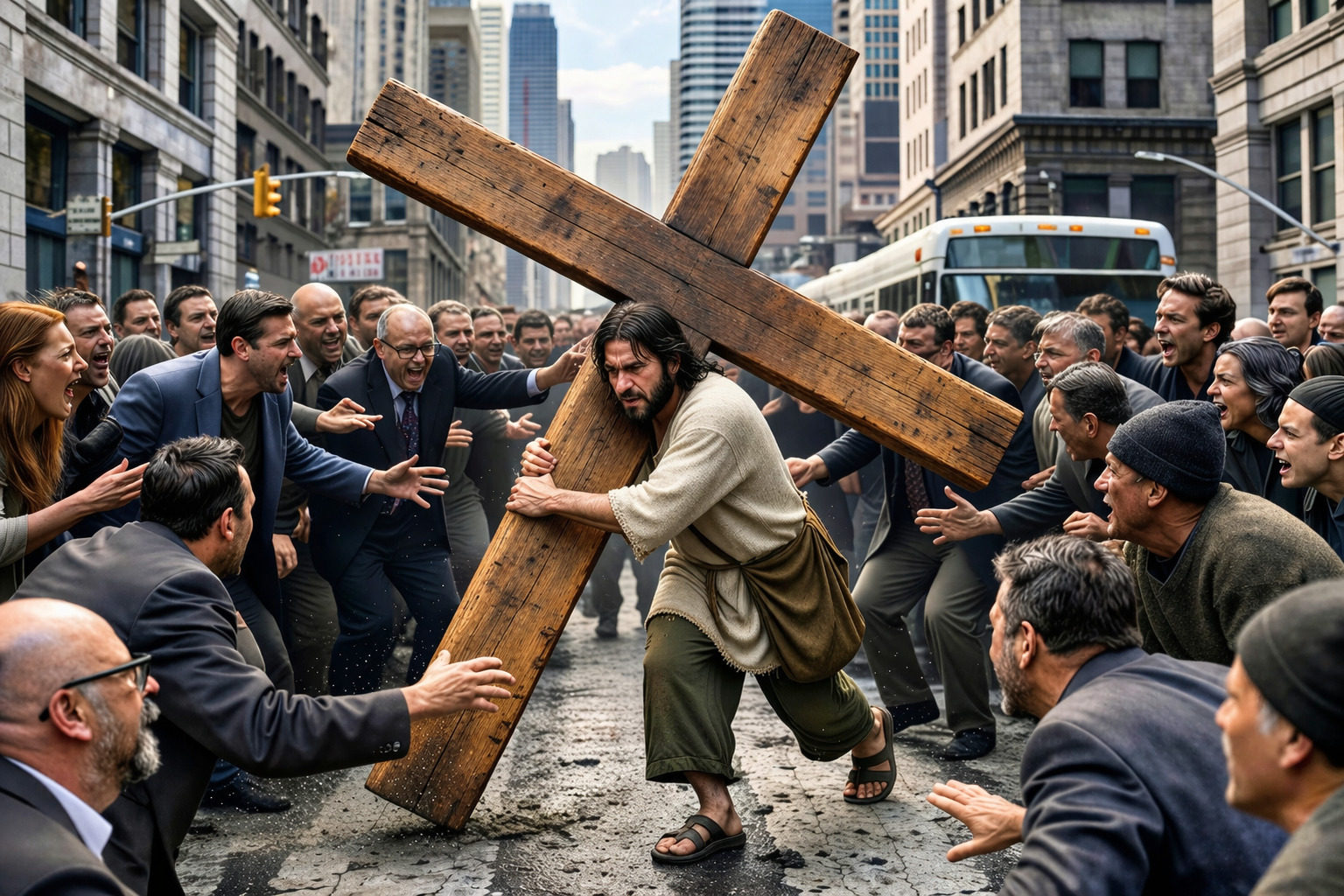
Taking up our cross and following Christ is not a metaphor for inconvenience, nor a poetic way of describing life’s ordinary hardships. It is a decisive, life-altering call, one that confronts the deepest instincts of the human heart and challenges even the most devoted believer.
Jesus did not invite His followers to admire Him from a safe distance. He called them to die, to self, to ambition, to the illusion of control, and to follow Him into a way of life shaped by surrender.
Then Jesus said to His disciples, “Whoever wants to be My disciple must deny themselves and take up their cross and follow Me. For whoever wants to save their life will lose it, but whoever loses their life for Me will find it. What good will it be for someone to gain the whole world, yet forfeit their soul? Or what can anyone give in exchange for their soul?” (Matthew 16:24–26)
These words are not symbolic flourish. They are a summons. And they force every believer to reckon with a question that cannot be avoided: What does it actually mean to take up our cross and follow Jesus?
Too often, we reduce the cross to a stand-in for everyday struggles: stress, disappointment, hardship. But embracing the cross goes far beyond enduring difficulty. It is about total surrender to Christ, the willing embrace of self-denial, and a life oriented toward obedience rather than self-preservation.
To understand this call rightly, we must first understand the cross itself.
Understanding the Cross
The cross is not merely a religious symbol. It is the instrument through which Jesus accomplished redemption, by willingly enduring suffering, shame, and death in obedience to the Father’s will.
In the first century, the cross represented utter humiliation. It was reserved for criminals, rebels, and enemies of the state. It was public, degrading, and designed to strip a person of dignity before taking their life.
Yet Jesus, the innocent Son of God, embraced the cross freely. He did so not under compulsion, but in love. Throughout His ministry, He spoke openly of His coming suffering, fully aware that obedience would lead Him there.
Nowhere is this more evident than in the Garden of Gethsemane. On the night before His crucifixion, Jesus experienced such anguish that He sweat drops of blood as He wrestled with the weight of what lay ahead. In that moment, He modeled the very surrender He would later call His disciples to embrace.
When Jesus calls us to take up our cross, He is not asking us to endure life’s inconveniences with stoicism. He is inviting us into the same posture of surrender, obedience, and self-denial that He Himself embodied.
Taking up our cross means releasing our grip on fear, control, and self-directed purpose. It means accepting that faithfulness to Christ will involve suffering, resistance, and at times persecution. But it also means trusting that God’s purposes, however costly, are good.
When we understand the cross rightly, we no longer approach hardship as something meaningless or accidental. We approach it with humility, submission, and a willingness to trust God’s will above our own, just as Jesus did.
The Call to Surrender
Surrender is not a peripheral aspect of discipleship. It is at the very heart of taking up our cross and following Jesus.
To surrender is to relinquish our claim to self-rule and to submit ourselves fully to the will of God, trusting that His plans are not only sovereign, but good. This kind of surrender is neither passive nor abstract. It is lived out daily, often in ways that confront our deepest desires.
In our personal lives, surrender means releasing control, especially when our plans falter or our understanding falls short. It requires seeking God through prayer, immersing ourselves in His Word, and trusting His guidance even when the path forward is unclear.
“My Father, if it is possible, may this cup be taken from Me. Yet not as I will, but as You will.” (Matthew 26:39)
Jesus’ prayer in Gethsemane reveals the true nature of surrender. It does not deny the weight of suffering, nor does it pretend obedience is painless. Instead, it yields, even when yielding is costly.
Surrender reaches into ordinary life. It lays down pride and expectation in our relationships. It submits our plans, ambitions, and outcomes to God. It loosens our grip on resources and replaces anxious control with trust. This is not loss for loss’s sake. It is the beginning of a life rightly ordered under Christ.
Embracing Self-Denial
Self-denial is not an optional discipline reserved for especially devout believers. It is inseparable from the call to take up our cross.
To deny ourselves does not mean rejecting our humanity or despising physical needs. It means refusing to place the self at the center. It is the deliberate decision to subordinate personal desire to the will of God.
“But seek first the kingdom of God and His righteousness, and all these things will be added to you.” (Matthew 6:33)
Jesus’ words confront the instinct to secure our own comfort, status, and provision. Self-denial reorders our priorities. God’s kingdom comes first, not as a slogan, but as a governing reality.
At the heart of self-denial is humility. It is the recognition that our desires, instincts, and preferences are not infallible guides. A humble heart is willing to yield—even when yielding involves sacrifice, inconvenience, or loss.
Self-denial takes tangible form. It appears in acts of service that go unseen. In restraint where indulgence would be easier. In forgiveness when resentment feels justified. In fasting, generosity, patience, and grace.
As we practice self-denial, something profound occurs. We are slowly freed from the tyranny of the self. Our desires are reshaped. Our affections are redirected. And we begin to resemble Christ, not only in belief, but in posture and action.
Denying ourselves is not the loss of life. It is the pathway through which true life is found.
What the Cross Exposes
Suffering is not an interruption of the Christian life. It is one of the primary means by which obedience is tested. Wherever allegiance to Christ is real, pressure will follow, not to destroy faith, but to reveal it.
“Indeed, all who desire to live a godly life in Christ Jesus will be persecuted.” (2 Timothy 3:12)
When Jesus calls us to take up our cross, He is not warning us about inconvenience. He is telling us that loyalty to Him will collide with the world, the flesh, and our instinct for self-preservation. Trials are not proof that faith has failed. More often, they are the moment faith is exposed.
Scripture treats suffering as a revealer rather than a creator. Like fire applied to precious metal, trials do not manufacture faith; they uncover what was already there and burn away what cannot endure.
Pressure does not introduce new problems into the believer’s life; it reveals which loyalties were already in conflict. What survives the fire was never sustained by comfort to begin with.
Perseverance, then, is not passive endurance. It is the refusal to retreat when obedience becomes costly. It is what happens when old reflexes are denied room to rule and the will is brought back under submission to Christ.
In this way, suffering exposes more than weakness. It exposes purpose. It reveals where God is pruning, where dependence is still divided, and where the self must finally yield so that Christ may be formed.
What God comforts, He also sends. And what He sends is not theory, but lived mercy, forged in affliction, tested by obedience, and carried forward for the sake of others.
Community Under the Cross
Taking up the cross is never a solitary act. Obedience is personal, but it is not private. Those who die to self are joined to others who are being brought through the same death.
The early Church did not form around shared preferences or convenience. It formed around shared submission. Believers gathered because Christ had gathered them, and because isolation was not survivable for a cruciform life.
Community is not a supplement to discipleship. It is one of the means by which the cross continues its work. In the presence of other believers, blind spots surface, pride is checked, and obedience is tested in ways solitude never exposes.
The body of Christ does not exist to affirm the self, but to conform it. When rightly ordered, community becomes a place where love is practiced, good works are provoked, and Christ’s life is made visible through many members sharing one obedience.
Forgiveness as Death to Self
Forgiveness is one of the clearest places where taking up the cross becomes unavoidable. Few commands strike the old self more directly.
Jesus’ teaching on forgiveness exposes a hard truth: those who refuse to forgive reveal how little they have understood their own mercy. The cross levels all moral hierarchies. No one approaches God as a creditor.
Forgiveness is not denial of harm, nor is it the erasure of justice. It is the relinquishing of the right to retaliate. It is the death of the demand to be repaid. In this way, forgiveness is not sentimental; it is cruciform.
Reconciliation, where possible, carries this death outward. God did not merely forgive from a distance; He moved toward enemies and absorbed the cost Himself.
To forgive, to pursue peace, to lay down resentment; these are not relational techniques. They are places where the cross finishes its work.
The Spirit’s Work in Sanctification
The life Jesus calls us into cannot be sustained by human resolve. If the cross depended on willpower, no one would survive it.
This is why the Holy Spirit is not optional to discipleship. He does not merely encourage obedience; He enables it. The Spirit applies what the cross has accomplished, working within the believer to put the old self to death and form Christ in its place.
Conviction, guidance, restraint, courage; these are not born of temperament or disposition. They are evidences of the Spirit’s presence, quietly opposing the flesh and redirecting the will.
Sanctification is not self-refinement. It is cooperation. As the Spirit leads, the believer yields, again and again, until obedience becomes instinct and resistance loses ground.
Counting the Cost
Jesus never concealed the cost of following Him. To take up the cross is to relinquish ownership of one’s life.
Scripture bears witness to men and women who obeyed at great personal loss, leaving security, enduring rejection, choosing faithfulness over safety. Their stories do not glorify suffering for its own sake; they testify to a life no longer governed by self-preservation.
The cost of the cross is not theoretical. It touches ambition, reputation, comfort, and control. In some cases, it costs everything.
Yet this loss is not meaningless. What is surrendered is not wasted. What is laid down is taken up again. Reordered, redeemed, and returned under Christ’s lordship.
Life Found Through Loss
The cross does not lead to emptiness. It leads to life.
Those who lose themselves for Christ do not vanish; they are found. Freed from the tyranny of self, they discover peace that does not depend on circumstance, joy that does not require control, and purpose anchored beyond the fragile boundaries of this life.
Taking up the cross is not the end of life. It is the end of illusion. And in its place, Christ forms a people who no longer live for themselves, but for Him.