The Confession Conundrum
Chronic, unconfessed sin spreads like a cancer—sapping a believer’s strength, stealing their joy, and eventually bringing forth death (James 1:15). Left in the dark, it festers; brought into the light, it can finally die.
Hidden Struggle
Do you think those around you don't struggle like you? Consider the number of hands that shoot up after the prayer requests for the lost, indigent, and sickly. You know, that point when the minister asks:
“Are there any unspoken prayer requests?”
Believers have no problem openly sharing prayer requests for fleshly needs, but when it comes to habitual sin, publicly, we plead the fifth. Why? For Scripture clearly tells us that if we submit to the Spirit and openly confess, He will bring our flesh into subjection (Romans 8:13)—not by literally whipping ourselves or performing religious acts of penance, but as the Spirit uses the painful honesty of exposure to crucify our pride and break the power of hidden sin.
Private Confession’s Limit
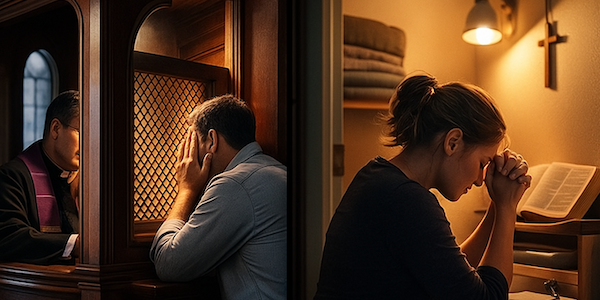
Protestants and Catholics hold doctrinal positions on confession their camps insist are diametrically opposed. Yet the dogmas share a systemic premise. Each believes the way to combat recurrent sin is to confess privately and discreetly. One says, “to a priest” (in Persona Christi), the other, “directly to God” (prayer closet).
Despite an act of contrition, private confession to a priest is akin to pleading guilty to a traffic violation, paying a fine or taking a remedial class to keep your driver's license. Absolution is given, a penance is prescribed and performed, then what?
Rather than teaching a chronic sinner to abhor and shun sin, the subliminal message is they retain a license to sin; that they can simply “pay for” any and all subsequent transgressions by slinking back to the confessional. Lather, rinse, repeat...
Why We Stay Stuck
Since God is privy to all our sin, private confession to Him sheds no new light on it. There is no reassuring ecclesiastical declaration of forgiveness in this scenario either. One can only assume their contrition is considered earnest and that any self-imposed penance will repair the damage and restore right relationship.
But more often than not this manner of confession does not alter the behavior of the soul caught up in a cycle of sin and sadly most leave in as weak and wretched a state as they entered. Lather, rinse, repeat...
Bringing Sin Into the Light
That is not to say that confessing sin to God or a priest is wrong or that each sin we commit needs to be dealt with publicly. But those darling sins of ours, those we return to repeatedly to our shame and dismay, the surest way to be cleansed of them is to expose them to the light by freely and openly confessing them (James 5:16). Confession is the believer’s appointed way of joining Christ in the public death of the old self—because the Cross was never meant to be borne in secret.
There is a moment in honest confession when every excuse, every justification, and every defense collapses. When a believer names their sin plainly, without softening or explanation, something in the flesh dies. The shame of exposure is not punishment—it is the breaking of pride. In that breaking, the cycle of sin loses its power. Light does not merely reveal; it destroys the hiding place where sin grew strong.
In the early church, confession was not whispered behind a screen; it was witnessed. Acts 19:18 shows believers openly declaring their sins and practices, and James 5:16 assumes mutual visibility. The biblical pattern is not secrecy but exposure—not private murmuring but shared repentance. The Cross was public, and the death of the old self follows the same path.
Public confession is humiliating, yes, but unfettered honesty is cathartic (Acts 19:18). And lest we forget, God gives grace to the humble but resists the proud (1 Peter 5:5–6).
The Strength of Open Confession
Fact of the matter is there is not a more grace-full and patently scriptural way to claim God's promise of being cleansed of chronic sin than open, honest, inglorious public confession. The point is not to dangle future humiliation as a threat, but to step willingly into the Light where the old self dies, pride is stripped away, and the Spirit establishes new patterns of obedience in the very places where we once hid.
Jesus’ parable of the wheat and the tares (Matthew 13:24–30, 36–43) reminds us that sincere believers and pretenders grow side by side until the harvest. Public confession does not wait for a perfectly safe room full of perfectly mature saints. Some will respond with grace, others with discomfort or even scorn. That risk is part of the Cross. We don’t confess because others are worthy; we confess because Christ is.
There may never be a congregation that feels “safe enough” for confession in human terms, but there will always be a Savior who is strong enough to meet us in the light. Healing begins wherever fear ends and honesty begins.
If you’re wrestling with hidden sin, we encourage you to start with The Darkness That Follows You Home, a featured study in the Faith Works section and a doorway into the Spirit’s revival of Apostolic Confession. It reveals how sin survives in secrecy and why the Church must return to the early-Christian pattern of bringing darkness into the light. While you’re there, you’ll also find other helps for believers who are serious about walking in truth and freedom.